
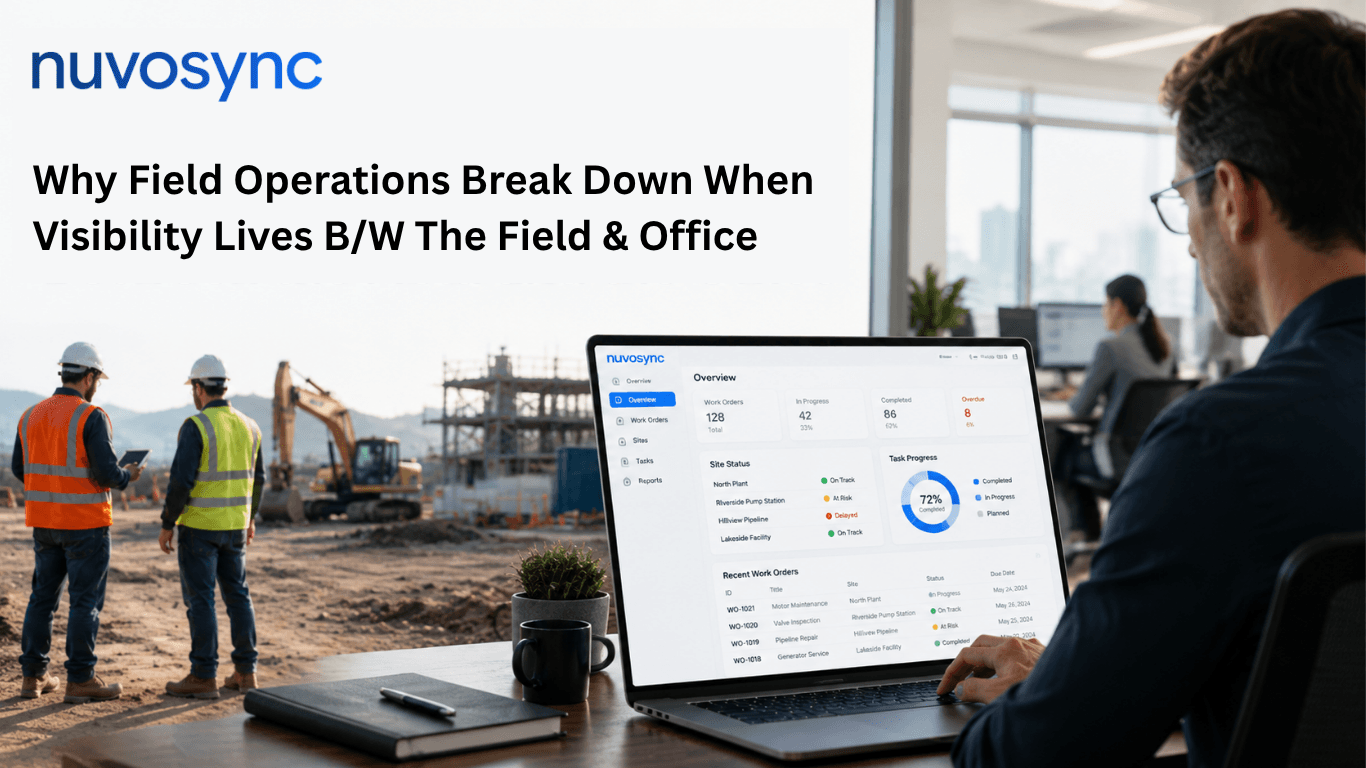
Field operations rarely fail because people are not working. They fail because the information created in the field does not move cleanly into the office, and the people responsible for decisions are forced to work with delayed, fragmented or incomplete context.
The field is moving. The information is not.
A field team can be working exactly as planned while the office still has an outdated picture of what is happening. A supervisor may know that a work order has changed, a site has a constraint, or a task is falling behind. That information may exist in a call, a message, a spreadsheet or a daily report, but the people who need the wider operational picture may not see it until later.
This is where the gap between execution and visibility appears.
The problem becomes more serious when an organisation manages multiple sites, multiple teams and a large number of work orders at the same time. The field is producing information continuously, but the office often receives it in batches. By the time a report is reviewed, the situation may already have changed.
The result is not simply a reporting problem. It becomes an execution problem.
Why reporting alone does not solve operational visibility
A daily report can tell an organisation what happened. It does not necessarily help it understand what is happening now.
That distinction matters. If a site has a delayed task, the useful question is not only whether the task was completed yesterday. The useful questions are what is pending, what is blocked, who owns the next action, and whether the issue needs attention before it affects the wider operation.
When field updates are treated as isolated reports, managers have to interpret them manually. They compare updates, call people for clarification and reconcile information from different locations.
The organisation may technically have data. What it lacks is a connected operational view.
The handoff between field teams and office teams
Field and office teams work with different realities.
The field team is dealing with physical work, site conditions, task completion and immediate constraints. The office team is dealing with schedules, priorities, resources, management decisions and broader visibility.
A useful operational system has to connect those two perspectives without making either team work around the limitations of the software.
This is the thinking behind NuvoSync.
NuvoSync is designed as a workforce execution and operational visibility platform that connects field teams to office teams through structured work orders, updates and site-level visibility. The objective is not simply to collect field information. It is to make that information useful to the people coordinating the operation.
From work orders to operational context
A work order is more useful when it exists inside context.
The organisation needs to know what the work is, where it is happening, who is responsible, what its current status is and what needs to happen next. When those details remain connected, a manager can understand an issue without starting a separate investigation every time.
NuvoSync brings work-order management and real-time site-level visibility together so that execution can be viewed as an ongoing operational process rather than a series of disconnected updates.
That is important for organisations where work is distributed across sites and teams. The office should not have to reconstruct the field from individual messages.
Why visibility changes the way managers work
Better visibility does not mean managers need another dashboard to watch.
The value is that decisions can start from a clearer picture.
A manager can identify what is pending, see where attention is needed and coordinate with the field team using a shared operational record. Instead of waiting for the next reporting cycle to discover a problem, the organisation has a better chance of responding while the work is still in progress.
This shifts the role of operational technology.
The goal is not to report execution after the fact. It is to support execution while it is happening.
The real objective is connected execution
Field operations are ultimately about getting work completed across real locations, teams and constraints. Technology is useful when it reduces the distance between the people doing the work and the people responsible for coordinating it.
NuvoSync is built around that connection.
It brings work orders, field updates and site-level operational visibility into one platform so organisations can move from fragmented reporting toward a more connected execution model.
The principle is simple: the field should not have to operate without context, and the office should not have to manage the field without visibility.
When those two sides work from the same operational picture, better decisions become easier to make.
What this means for the organisation
The larger lesson is that operational visibility should not be treated as a reporting exercise that happens after work is completed. When field execution and office coordination share a clearer operational context, managers can spend less time reconstructing status and more time deciding what needs attention. NuvoSync's role is to provide that connected layer between field teams and the office.
Where operational delays become expensive
The operational cost of poor visibility is rarely limited to one delayed task. A small issue at one site can require a series of calls, follow-ups and status checks before the office understands what is happening. While that clarification is taking place, the field team is still dealing with the original issue.
This is why context matters more than a number on its own. A status such as “pending” tells the office that work has not been completed. It becomes more useful when the surrounding information makes the reason, ownership and next action visible.
For distributed operations, that context can reduce the time between an issue appearing and the right person understanding it. The objective is not to create pressure for field teams to update endlessly. It is to make the updates they already create more useful to the wider operation.
One operational picture does not mean one team does all the work
Connected execution does not mean the field team and office team suddenly have the same responsibilities. Their roles remain different.
The field team still owns execution at the site. Supervisors still manage the work in front of them. Office teams still coordinate priorities and broader operational decisions.
What changes is the information connecting those roles.
When the same work order and site context can be understood across the operation, fewer conversations have to begin with “What happened?” The conversation can move faster toward “What needs to happen next?”
That is the kind of operational improvement software should support: not replacing people, but reducing the friction between them.
Visibility is most useful when it leads to action
A platform can collect a large amount of operational information without necessarily improving execution. The real value appears when the information helps someone decide what deserves attention.
That is why NuvoSync's positioning is built around workforce execution and operational visibility rather than reporting alone. The system is intended to connect work orders, field teams and site-level information so that the office has a clearer understanding of execution as it happens.
For organisations managing distributed work, that shift can be meaningful. The objective becomes less about producing another report and more about creating a dependable operational context from which teams can coordinate.
Where the product fits
NuvoSync is positioned as a workforce execution and operational visibility platform for distributed field operations. It connects field teams to office teams through work-order management and site-level operational visibility. The product story is about connecting execution with the people responsible for coordination and decisions.
A better operating rhythm
The purpose of a connected workflow is not to create constant monitoring. It is to establish a more dependable rhythm between execution and coordination.
Field teams update work as it progresses. The office can review the operational picture, identify what needs attention and coordinate accordingly. That creates a cycle in which information supports action instead of simply documenting the past.
For organisations with distributed work, that shift can make operational management more deliberate. The team is not waiting for a problem to become a report before it becomes visible.
The difference between knowing and understanding
Operational teams often have plenty of information. The harder problem is understanding which information matters now.
A status update, a work order and a site report can each be accurate while still leaving a manager without enough context to act. Connected visibility changes that by bringing the relevant operational details closer together.
This is particularly important when work is distributed. The farther the people making decisions are from the physical work, the more important a dependable operational record becomes. NuvoSync is designed around that distance: connecting field execution with office coordination so the organisation has a clearer picture of what is happening across sites.